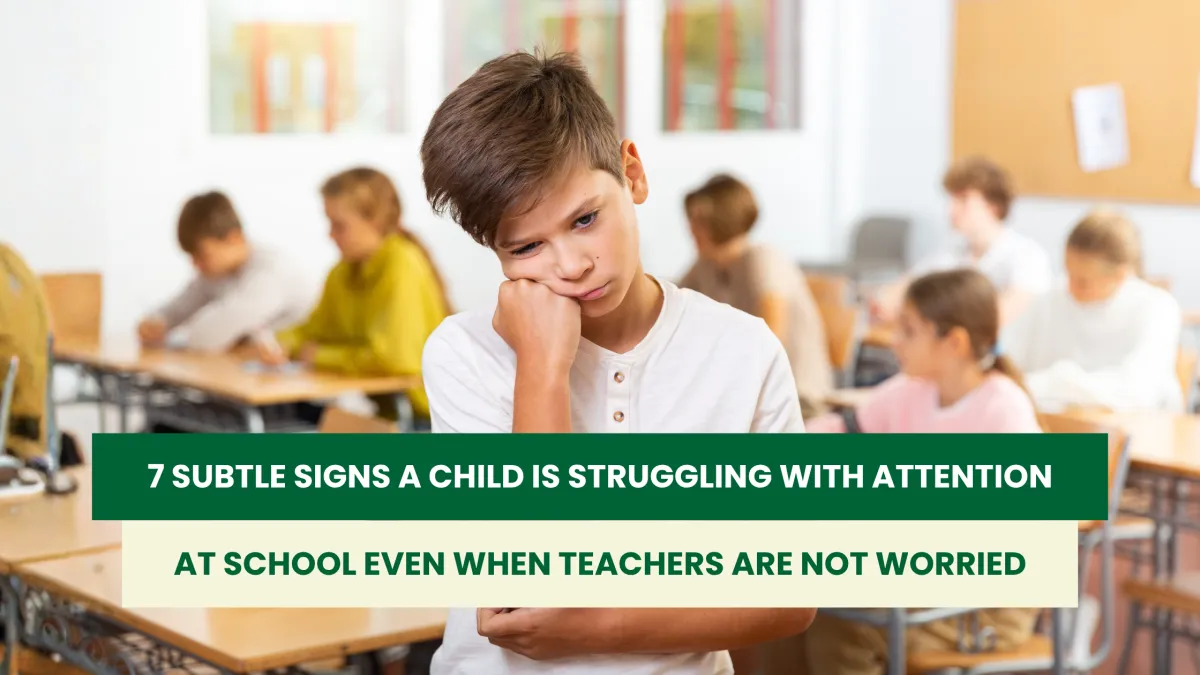
7 Subtle Signs a Child Is Struggling with Attention at School
Some of the kids who struggle the most in school are the ones nobody is worried about.
They are quiet. They are compliant. They do not cause trouble. On the surface, everything looks fine.
But many of these kids are working twice as hard just to keep up, and their effort can hide attention or executive functioning struggles for a long time.
I am Dr. James Thatcher, a licensed psychologist at Forest Psychological Clinic in Portland, Oregon. After working with thousands of kids and teens, I have seen the same subtle patterns come up repeatedly, and these are patterns schools sometimes miss.
By the end of this article, you will know what to look for so your child does not get overlooked, mislabeled, or misunderstood at school.
Quick note. This is not medical advice. It is education based on patterns I commonly see in clinical work.
If you are in Portland, Oregon or nearby and want support, you can request a consultation for therapy at forestpsychologicalclinic.com. We also offer autism evaluations as well as ADHD evaluations at our clinic.
1. Quiet and compliant at school, falling apart at home
This is one of the biggest patterns I see.
Because the child is not disruptive, it is assumed they are doing fine. Teachers often reward calm behavior. What can go unseen is the internal effort it takes to stay focused and regulated all day.
Then the child gets home and the mask comes off.
Homework becomes a battle. They refuse. They shut down. They seem inattentive. They melt down over something that looks small.
If school says everything is fine but home looks completely different, that is a red flag. It does not mean school was easy. It may mean your child used everything they had just to get through the day.
2. Homework takes an unusually long time
Parents often tell me their child is sitting at the table for hours for work that should take far less time.
This is usually not occasional. It is consistent.
Sitting down to do homework is not the same as sustaining attention.
Many kids want to do it, but the task feels overwhelming. They do not know where to start, or they cannot keep momentum once they begin.
One support that can help is making time more concrete.
A visual timer, breaking homework into smaller visible chunks, or using a short checklist can reduce overwhelm. These tools do not fix attention, but they can reduce the stress that blocks action.
3. Labeled as lazy or bad at time management
This is one parents should listen for.
If your child is being described as lazy, unmotivated, or having poor time management, and that feedback does not match what you see at home, it should raise a red flag.
Many parents will say, my child is smart, my child cares, and I see them trying.
When a child performs well in some areas but struggles significantly in others, it can be time to stop asking whether this is an effort problem and start asking whether it could be an executive functioning issue.
4. Daydreaming, zoning out, and missing instructions
Teachers may say they are giving instructions but the child is not absorbing them. They have to repeat themselves.
Parents often see the same thing at home. A multi-step direction gets started, then the child trails off, forgets, or gets pulled into something else.
This is not necessarily defiance.
Often this points to working memory and attention regulation. Holding multiple steps in mind while doing them can be difficult for kids with executive functioning challenges.
5. Emotional sensitivity that gets misread
Emotional sensitivity is another subtle sign, especially around feedback.
Many kids with attention differences respond strongly to tone and correction. When feedback is mostly negative or corrective, you may see shutdown, discouragement, or meltdowns.
This can be easy to miss in kids who are people pleasers and highly compliant. It is also one reason attention struggles can be overlooked, especially in girls who are trying hard to be good and not make mistakes.
6. Inconsistent performance
Schools may report that on some days your child gets it and on other days it is like they do not get it at all.
This pattern often fits attention differences.
ADHD is not simply a lack of attention. It is often difficulty regulating attention.
That is why some kids can hyperfocus for hours on something they love but struggle to engage with non-preferred school tasks.
Inconsistent performance can also show up as rushing. The child understands the material but speeds through to be done and makes careless mistakes.
Small environmental changes can help some kids.
Reducing background noise, using noise-canceling headphones, or working in a quieter space can make attention easier to regulate. These supports are not about effort. They are about the environment.
7. The most concerning sign: “Why is this so hard for me”
This is the sign I take most seriously.
When kids start asking why school is so hard for them, it often means they are noticing it feels easier for other kids. Sometimes they notice it is easier for their siblings.
Over time, that question turns into self-doubt.
When your child starts believing the problem is them, it is usually time to stop focusing on effort and start looking closely at how attention and executive functioning are working for them.
What to do if these signs sound familiar
If any of this sounds familiar, it does not mean anything is wrong with your child.
It may mean your child is neurodivergent and is trying to function in a system built for neurotypical attention.
A helpful next step is to gather concrete examples, talk with teachers, and consider professional support if functioning or self-esteem is being affected.
If you are in Portland, Oregon or nearby and you want help understanding what is going on, Forest Psychological Clinic works with neurodivergent kids, teens, and families around these exact concerns. You can request a consultation for therapy or an evaluation at https://forestpsychologicalclinic.com/contact
FAQ: Quiet kids, attention, and executive functioning
Can a child have ADHD if they are quiet and well behaved
Yes. Many kids with attention differences are not disruptive. Some are internally anxious, perfectionistic, or highly compliant, which can hide struggles at school.
Why does my child hold it together at school but fall apart at home
School can require intense focus and self-monitoring. When your child gets home, the pressure drops and their nervous system finally releases, which can look like shutdown, irritability, or refusal.
How long should homework take
There is no perfect number, but if homework consistently takes far longer than expected for your child’s grade level, and it causes stress or conflict, it can be a sign that attention or executive functioning is interfering.
What is executive functioning
Executive functioning refers to skills like starting tasks, planning, organizing, sustaining attention, using working memory, and regulating emotions. These skills develop over time and can be impacted by ADHD, anxiety, learning differences, and autism.
When should we consider an evaluation
If your child is struggling to function at school or home, if teachers are labeling them as lazy or unmotivated, if homework is consistently overwhelming, or if self-esteem is dropping, an evaluation can help clarify what is going on and guide supports.

