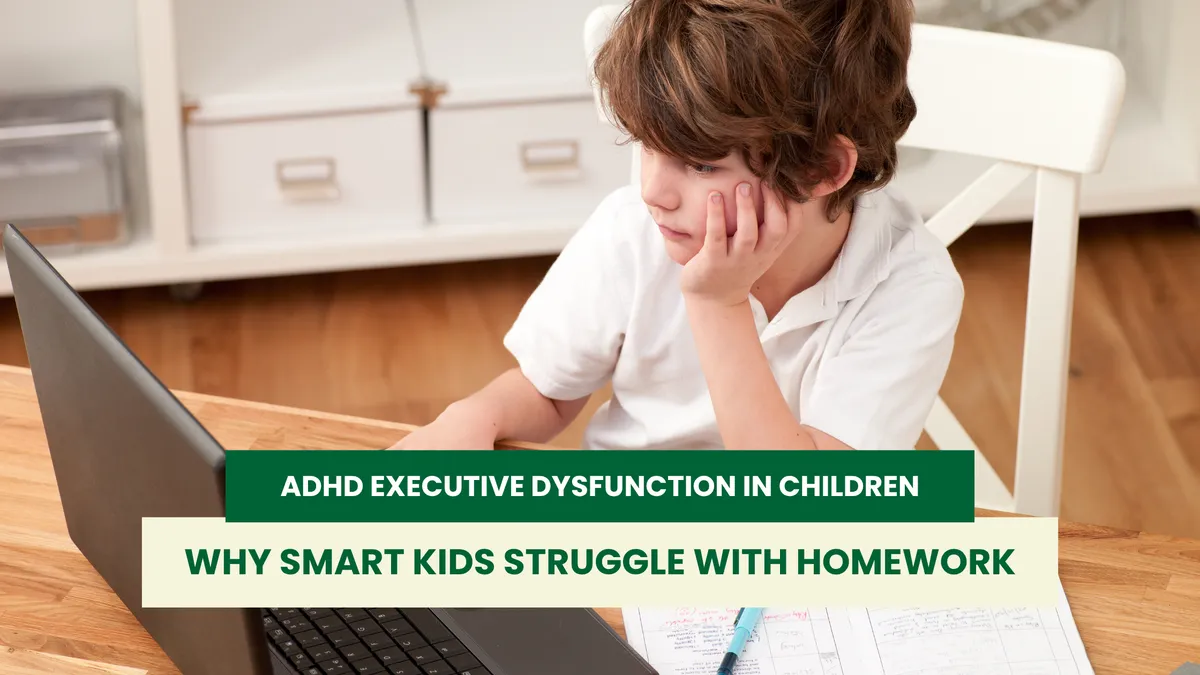
ADHD Executive Dysfunction in Children: Why Smart Kids Struggle With Homework
Your child is bright. They understand the material. They may be able to talk for hours about subjects that interest them.
So why does starting a homework assignment feel impossible?
Why are you still reminding them to get dressed, pack their backpack, or turn in an assignment they completed three days ago?
And why does Sunday night sometimes turn into a full-blown crisis?
For many children and teens with ADHD, the problem is not intelligence or laziness. It is executive dysfunction.
Executive functioning difficulties can make it harder to start tasks, organize work, estimate time, remember multiple steps, and regulate emotions. When those challenges combine with procrastination, a bright child may be able to compensate for years by relying on last-minute panic.
They get the assignment done.
They may even get a good grade.
But eventually, that strategy can contribute to anxiety, sleep problems, homework battles, and school burnout.
What Is Executive Dysfunction in ADHD?
Executive functioning refers to a collection of mental skills that help us manage our behavior and accomplish goals.
Think of executive functioning as the brain's management system.
It helps us determine:
What needs to be done?
Where should I start?
What materials do I need?
What comes next?
How long will this take?
How do I stay focused long enough to finish?
How do I manage frustration when something becomes difficult?
These skills are separate from intelligence.
A large meta-analysis of 83 studies found significant executive-function weaknesses among people with ADHD, particularly in areas including working memory, planning, vigilance, and inhibition. Importantly, these differences were not simply explained by differences in intelligence or academic achievement (Willcutt et al., 2005).
That helps explain something parents frequently find confusing:
A child can be extremely intelligent and still have significant difficulty managing school.
Working Memory
Working memory allows us to hold information in our minds while we use it.
For example, your child may understand a teacher's three-step direction but forget step two while completing step one.
Task Initiation
Task initiation is the ability to begin.
A child may know exactly what needs to be done and still feel unable to get started.
This can look like procrastination, avoidance, staring at a blank document, wandering around the house, or suddenly deciding that reorganizing their bedroom is extremely important.
Planning and Organization
Planning involves figuring out what needs to happen first, what materials are required, and how to break a larger assignment into smaller pieces.
A five-page paper is not one task.
It may involve choosing a topic, finding sources, reading them, taking notes, creating an outline, writing a draft, revising it, formatting it, and submitting it.
A child struggling with executive functioning may simply see:
Write a five-page paper.
And have no idea where to begin.
Time Awareness
Many kids with ADHD also struggle to accurately experience or estimate time.
"I'll start in five minutes" becomes 45 minutes.
An assignment they believe will take 20 minutes actually takes two hours.
Or they assume they have plenty of time because the project is not due until Friday, only to discover Thursday evening that they have dramatically underestimated the amount of work involved.
Emotional Regulation
Executive functioning is also affected by emotion.
When a child becomes flooded with anxiety, anger, embarrassment, or frustration, planning and problem-solving can become significantly harder.
Research supports the importance of emotion regulation in ADHD. A meta-analysis involving 77 studies and more than 32,000 young people found substantial differences in emotional functioning among youth with ADHD, particularly in emotional reactivity, lability, and regulation (Graziano & Garcia, 2016).
That means a child's homework meltdown may not simply be a refusal to cooperate.
Sometimes they have become so overwhelmed that the very skills they need to solve the problem are becoming harder to access.
Why Smart Kids With ADHD May Procrastinate
There is a pattern I see frequently in bright children and teenagers with ADHD.
I call it the smart kid procrastination trap.
It usually looks something like this.
1. The Child Avoids the Assignment
The child puts off starting.
That can happen for many reasons.
They may not know where to begin.
They may have missed part of the instructions.
The assignment may seem enormous.
They may be anxious about doing it incorrectly.
Perfectionism may tell them that if they cannot do it perfectly, they should not start at all.
Or simply thinking about the assignment may have become so unpleasant that avoiding it provides temporary relief.
2. The Deadline Creates a Crisis
Eventually, the deadline gets close enough that the assignment can no longer be ignored.
Now there is urgency.
Panic sets in.
Suddenly, your child can work.
They stay up late studying.
They write the paper at midnight.
They finish the presentation at 1 a.m.
The same child who seemed physically incapable of beginning the assignment three days earlier may suddenly complete hours of work in one night.
3. They Get Away With It
Then something very important happens.
They pass.
Maybe they get a B.
Sometimes they get an A.
The project gets turned in, everyone survives, and the immediate crisis ends.
4. The Procrastination Gets Reinforced
The child's brain learns:
I waited. I panicked. The panic finally got me moving. I finished it. And it worked.
The strategy was miserable.
But it worked.
That makes it more likely to happen again.
5. Anxiety and Burnout Increase
Eventually, the cost starts accumulating.
The child loses sleep.
Homework becomes increasingly emotional.
Sunday nights become miserable.
Parents and children fight.
The child begins dreading school.
What originally looked like procrastination starts turning into chronic anxiety or burnout.
"I Wish I Would Fail So I Would Learn"
I once worked with an extremely bright teenager who was caught in this cycle.
He loved reading and philosophy. He could have sophisticated conversations about all kinds of subjects.
But his homework habits were incredibly difficult.
He would procrastinate until the night before an assignment was due.
Then he would work.
Midnight.
One in the morning.
Two.
Sometimes three.
He would grind through the assignment, turn it in, and because he was bright enough to pull it off, he would often receive a perfectly respectable grade.
One day he told me something I have never forgotten:
"I wish I would fail so I would learn."
He understood the problem.
Every time he procrastinated, panicked, stayed up most of the night, and still earned a decent grade, his brain received evidence that his strategy worked.
Except the strategy was slowly burning him out.
That is one reason good grades do not always mean a child with ADHD is functioning well.
Sometimes their intelligence is allowing them to compensate for executive-function difficulties at an enormous personal cost.
What Parents Can Do About ADHD Homework Problems
The solution is generally not to tell a child to "try harder."
Instead, we want to build enough structure around the task that they have somewhere to begin.
1. Focus on the First Five Minutes
"Do your homework" is an enormous instruction.
Instead, ask:
What can we do in the next five minutes?
That might mean:
Open your laptop.
Log into the school portal.
Find the assignment.
Read the first two instructions.
Write your name and the date.
Complete one problem.
Then reassess.
Think about this as starting-line thinking rather than finish-line thinking.
For a child who feels overwhelmed, "finish your homework" may contain 30 invisible steps.
"Open your laptop" contains one.
2. Externalize the Plan
If your child's entire organizational system lives inside their brain, it can disappear as soon as they become stressed.
Put the plan outside their brain.
You might use:
A homework checklist
A visual timer
A whiteboard
A written first-then plan
A planner
A visible morning routine
A checklist for larger projects
There is good evidence for directly teaching these types of organizational skills.
A meta-analysis of 12 studies involving 1,054 children with ADHD found that organizational-skills interventions improved organizational abilities, with more modest improvements also seen in inattention and academic performance (Bikic et al., 2017).
Instead of repeatedly telling a child to "be more organized," we want to create systems that actually teach organization.
3. Break Homework Into Chunks
Instead of:
"Finish all of your homework."
Try:
"For the next 20 minutes, we're only working on math."
Set a timer.
When the timer goes off, take a short break.
Then:
"For the next 20 minutes, we're working on history."
Breaking work into chunks can make a large workload feel more manageable.
"This is going to take forever" becomes:
"I can do 20 minutes."
It can also help prevent the child from reaching a level of frustration where productive problem-solving becomes much harder.
What Should You Say When a Child With ADHD Says "I Can't"?
When your child says:
"I can't do this."
Try not to immediately respond:
"Yes, you can."
You may be correct, but arguing about whether they can do it often misses what they are communicating.
Instead, try four steps.
Reflect the Emotion
"This feels really overwhelming right now."
Get Curious
"What part feels too big?"
"Are you unsure where to start?"
"Are you worried you're going to get it wrong?"
Reality-Check the Problem
"You're right. You have quite a bit to do. But you have three assignments, not 30. Let's figure out the first one."
Give Them One Small Next Step
"For the next 20 minutes, we're only doing math. Then we'll take a break."
If your child is extremely upset, it may also be appropriate to briefly pause.
"You seem really overwhelmed. Let's take five minutes to settle down, and then we'll come back and do the first step together."
You are acknowledging the child's experience without removing the expectation entirely.
How to Make ADHD Morning Routines Easier
For some families, homework is not the most difficult part of the day.
Mornings are.
One common mistake is having a child set their alarm long before they genuinely need to wake up.
If they do not need to get out of bed until 6:50 but their first alarm starts at 6:10, hitting snooze repeatedly may simply disrupt an additional 40 minutes of sleep.
Instead, build a realistic wake-up time and externalize the routine.
For example:
6:50: Get out of bed
6:55: Bathroom
7:05: Get dressed
7:15: Breakfast and medication
7:30: Brush teeth and gather belongings
7:40: Shoes and backpack
7:45: Leave
The exact routine will vary by family.
The important part is that the parent does not have to serve as the child's external working memory every single morning.
If you find yourself saying:
"Get dressed."
"Brush your teeth."
"Where is your backpack?"
"Did you take your medication?"
"Get your shoes on."
"We have to leave."
every morning, move as much of that information as possible onto a visible system.
And prepare ahead whenever you can.
Pack backpacks the night before.
Prepare lunch.
Lay out clothing.
Charge electronics.
Find sports equipment.
Anything that eliminates one more potential morning emergency helps.
Three ADHD Parenting Patterns That Can Backfire
Parents are usually trying to help when they fall into these patterns, but they can sometimes maintain the cycle.
Repeated Nagging
You remind your child.
Nothing happens.
You remind them again.
You get louder.
They become frustrated.
You become frustrated.
Eventually everyone is upset.
If repeated verbal reminders are not working, adding more reminders is usually not the best long-term system.
Externalize the expectation instead.
Consequences Without Skill-Building
Consequences can be appropriate.
But a consequence does not automatically teach a missing skill.
If your child has no idea how to organize a three-week project, losing access to their phone may provide motivation, but it does not teach them how to organize a three-week project.
Ask:
What skill or system was missing here, and how do we teach it?
Rescuing at the Last Minute
This is a difficult one because rescuing often comes from love.
Your child is panicking.
The assignment is due tomorrow.
You do not want them to fail.
So you jump in.
But if the repeated pattern becomes:
Procrastination → panic → parent rescue → assignment gets completed
the child may unintentionally learn that panic is part of the process.
Instead, aim for scaffolding.
Help them break down the task.
Involve school supports when appropriate.
Create structure.
And sometimes allow manageable natural consequences so they have an opportunity to learn that the system needs to change.
When Should You Seek Help for ADHD Executive Functioning Problems?
Do not use grades as your only measurement.
A child can be getting good grades while struggling tremendously.
Instead, look at the cost of maintaining those grades.
Consider seeking additional support if your child is:
Regularly staying up extremely late to complete schoolwork
Chronically exhausted
Experiencing frequent homework meltdowns
Becoming increasingly anxious about school
Dreading Sunday nights
Frequently refusing or attempting to avoid school
Struggling with organization despite repeated attempts to help
Having significant conflict with parents around homework
Appearing burned out even though they are technically passing
Support may include therapy, parent coaching, executive-function interventions, school accommodations, medication management when appropriate, or a comprehensive psychological evaluation if it is unclear what is contributing to the difficulty
ADHD Evaluations and Therapy in Portland, Oregon
If your child is struggling with ADHD, executive functioning, school anxiety, homework, or emotional regulation, getting a clearer understanding of what is happening can help determine the next step.
At Forest Psychological Clinic, we work with children, teenagers, adults, and families in the Portland area. We provide comprehensive ADHD and psychological evaluations as well as therapy and medication management.
A comprehensive evaluation should do more than provide a diagnosis. The goal is to understand your child's pattern of strengths and difficulties and develop practical recommendations that can be used at home and at school.
If you are looking for ADHD testing, therapy, or additional support in the Portland, Oregon area, you can learn more or contact us at ForestPsychologicalClinic.com
Your Child May Not Be Lazy
If there is one idea I want parents to take from this, it is this:
A bright child struggling with ADHD may not have a motivation problem. They may have a management problem.
Their current strategy may look something like this:
Avoid.
Wait.
Panic.
Sprint.
Recover.
Repeat.
That strategy can work just well enough to keep a smart child afloat for a surprisingly long time.
But it is not sustainable.
The goal is not to make your child become a different person.
The goal is to give them smaller starting points, external structure, realistic routines, emotional support, and the executive-function tools they need so that a crisis is no longer required to get started.

