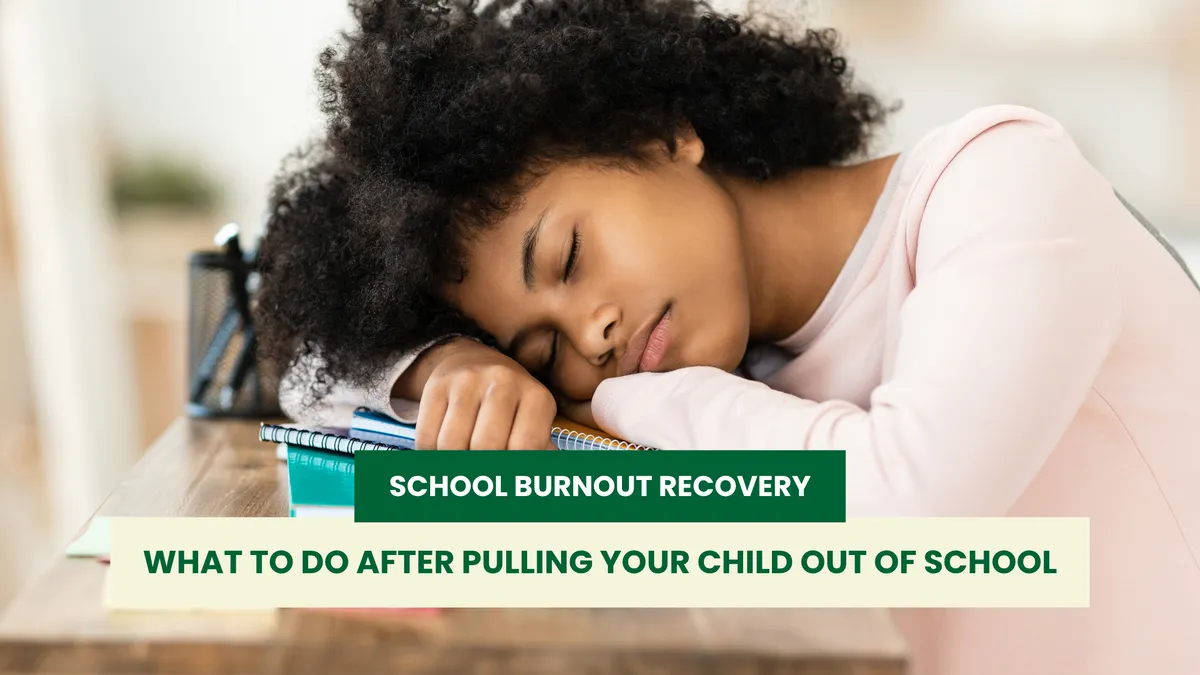
School Burnout Recovery: What to Do After Pulling Your Child Out of School
Taking your child out of school may stop the immediate harm.
But withdrawal itself isn't a recovery plan.
A lot of parents don't casually decide one morning:
"I think I'll pull my kid out of school today."
Usually something has been building.
Their child is shutting down.
They're refusing to go.
They're emotionally deteriorating.
They're being bullied.
They're barely sleeping.
They're coming home and collapsing every afternoon.
Eventually, the family reaches a point where continuing in the same environment no longer feels sustainable.
So the parent acts.
And then the next morning comes.
Your child is home.
And now you're thinking:
What do we actually do?
How long should I let them rest?
When should schoolwork start again?
How much structure should they have?
What if they sleep until noon?
What if they spend six hours gaming?
Should we switch to online school?
And how do I help them become independent again without recreating the exact same burnout that got us here?
Those are the questions I want to focus on.
Getting Your Child Out of School and Helping Them Recover Are Two Different Decisions
Sometimes parents have to act before they have a perfectly researched plan.
If a child is deteriorating emotionally or no longer feels safe, protecting them may need to happen first.
If your child is actively suicidal, seriously harming themselves, or in immediate danger, school planning becomes secondary. In the United States, call 911 for an immediate emergency or 988 for suicide and crisis support.
But once immediate safety is addressed, there's a second question:
How do we help this child recover?
The first decision may have been:
We need to get them out of this situation.
The next one is:
How do we build something sustainable in its place?
Autistic Students Are More Likely to Experience School Absence
There is research showing that school attendance difficulties are particularly relevant for autistic children and teens.
A 2024 scoping review by Nordin and colleagues examined 42 studies on school absenteeism in autistic children and adolescents.
The researchers found that autistic students had a higher risk of school absence than non-autistic students. School absence was often associated with mental-health difficulties and additional neurodevelopmental conditions, but school factors mattered too. The review specifically identified issues such as bullying and a lack of autism understanding within schools (Nordin et al., 2024).
That's important.
When a neurodivergent child stops attending school, we shouldn't automatically assume:
The child is the problem.
Sometimes the school environment itself has become part of the problem.
And once a child is removed from that environment, we still have to understand what happened so we don't simply recreate it somewhere else.
Step One: Let the Nervous System Stabilize
If your child has been under intense pressure for months, they may need a period where the demands come down.
They may need to catch up on sleep.
Eat regular meals.
Reconnect with family.
Spend time doing things that feel safe and predictable.
You may see them sleep much more than usual.
Or you may see the opposite.
They stay up incredibly late.
Sometimes nighttime becomes the only part of the day when nobody is expecting anything.
Nobody is asking about school.
Nobody is asking:
"What are you going to do tomorrow?"
Nobody wants homework.
The house is quiet.
So they stay awake.
You may also see your child disappear into a preferred interest.
Gaming.
Drawing.
Reading.
LEGO.
Watching the same show.
Researching one particular topic.
That doesn't automatically mean they're lazy or that leaving school was a mistake.
For some neurodivergent kids, those activities are predictable and regulating at a time when the rest of life has felt incredibly unpredictable.
What Does Autistic Burnout Look Like in Children and Teens?
Research on autistic burnout in young people is still developing, and I think we should be transparent about that.
One particularly useful 2021 study by Phung and colleagues directly interviewed eight autistic children and youth between ages 8 and 18 about burnout, inertia, meltdowns, and shutdowns.
The young people described experiences involving physical, emotional, and cognitive difficulties. They also reported that adults often misunderstood what was happening to them.
One of the clearest themes was the importance of compassion and collaboration from trusted adults rather than adults simply imposing solutions on them (Phung et al., 2021).
That's a small study, so I would not treat it as the final word on autistic burnout.
But I think the young people's perspective is worth taking seriously.
Recovery shouldn't just be something adults do to a child.
We need to involve the child too.
Ask:
"What feels hardest right now?"
"What makes your day worse?"
"What seems to help?"
"What part of school felt impossible?"
"What could make learning feel more manageable?"
Sometimes your child's answer tells you exactly where the missing support is.
Rest Is the Beginning of Recovery, Not the Entire Plan
This is where parents sometimes feel stuck.
You don't want to pressure your child.
But you also don't want six months to pass with no routine, learning, responsibility, or movement toward independence.
Both concerns make sense.
Recovery does not mean:
"You never have to do anything difficult again."
But it also doesn't mean:
"You've been home for four days. Time to catch up on everything you missed."
Initially, watch basic functioning.
Is sleep improving?
Are they eating more regularly?
Are they showering?
Are they coming out of their room?
Are you starting to hear them joke again?
Do they seem more like themselves?
Can they do something small and still function afterward?
There isn't a universal number of days or weeks that tells you when someone has rested enough.
Look at the child.
Structure Is Different From Pressure
Eventually, I want some structure back in the day.
But I don't mean turning your kitchen into another school.
Start with a few predictable anchors.
Maybe:
9:00: Wake up and get dressed
9:30: Breakfast and medication
10:00: Walk outside
11:00: Small amount of learning
12:00: Lunch
Afternoon: Preferred activity, appointment, household responsibility, or another manageable task
Evening: Dinner and family time
The exact schedule isn't important.
The rhythm is.
Pressure sounds like:
"When are you going to catch up?"
"You can't do nothing forever."
"You need to prove you can handle this."
Structure sounds more like:
"Here's what today is going to look like."
"We're going to work on one thing together."
"If that's too much, we'll figure out why and adjust it."
For many autistic and ADHD kids, simply knowing what is coming and how long it will last can lower a tremendous amount of stress.
Match the Demand to Your Child's Current Capacity
Right now they can do 15 minutes.
Start with 15 minutes.
Maybe they used to handle therapy, soccer, tutoring, and a doctor's appointment in the same week.
Right now one appointment wipes them out.
That's information.
Recovery doesn't mean accepting that level forever.
It means starting from a place they can actually sustain and building from there.
If you push a burned-out child far beyond their capacity every day, you may get productivity.
But you may also recreate the same burnout cycle in a different environment.
Research: Returning to School Is Not the Same as Recovering
This is a distinction I think parents, schools, and clinicians need to pay more attention to.
In 2025, Jakobsen and colleagues published a systematic review and meta-analysis of cognitive behavioral interventions for young people with school attendance problems.
The researchers included 15 studies and 932 young people.
Compared with control conditions, CBT-based interventions produced a medium improvement in school attendance.
But here's the part I think is really important:
The differences in anxiety and depression were not statistically significant compared with the control groups (Jakobsen et al., 2025).
The study was not specifically about autistic or ADHD children, so we shouldn't pretend it was.
But it illustrates an important point:
A child returning to school does not automatically mean the child has emotionally recovered.
A child can attend school.
Log in.
Turn in assignments.
Complete homework.
And still be struggling tremendously.
So don't measure recovery only by productivity.
Ask:
What does that productivity cost them?
Can your child do 30 minutes of schoolwork and still participate in dinner later?
Or does 30 minutes of work destroy the rest of the day?
Those are very different outcomes.
Online School Is Not Automatically Easier for ADHD or Autism
Online school can be an excellent option for some children.
But parents sometimes assume:
"School was overwhelming, so we'll just do online school. That should be easier."
Maybe.
But not necessarily.
This is especially important for kids with ADHD or significant executive-function difficulties.
Think about how much invisible structure exists in traditional school.
There are bells.
Teachers.
Class periods.
Visual schedules.
Other students getting up when you're supposed to move.
Adults reminding you:
"Open your book."
"This is due Friday."
"Turn this in."
"We're starting now."
Now move the child home.
All of that structure disappears.
Instead, assignments appear in an online portal.
Now the child has to:
Remember to log in.
Find the assignment.
Understand the instructions.
Know when it's due.
Decide when to start.
Prioritize it against everything else.
Gather the materials.
Stay focused.
Complete multiple steps.
Remember to submit it.
Ask for help if something doesn't make sense.
That's a huge amount of executive functioning.
A child may understand the academic material perfectly and still be unable to independently manage everything required to turn that knowledge into completed work.
Online School Can Recreate the Same Burnout at Home
This is why I get nervous when we change only the location.
If executive-function problems were one of the reasons school became unsustainable, moving the same assignments onto a laptop at home doesn't necessarily fix anything.
Now the child may have:
The same workload.
The same deadlines.
The same executive-function difficulties.
But less external structure.
The burnout can happen again.
Just in the bedroom instead of the classroom.
So when families switch to online school, homeschooling, or another alternative educational arrangement, I want them thinking about the support system around the learning, not only the curriculum itself.
Sometimes Parents Need to Lend Their Executive Functioning
This does not mean doing your child's homework.
It means helping them learn how to organize the process.
Sit down together.
Open the online portal.
Find everything that's due.
Put deadlines on a shared calendar.
Then take:
"History research project due November 20"
and make the invisible steps visible.
Choose a topic.
Find three sources.
Read the sources.
Take notes.
Make an outline.
Write the introduction.
Write the next section.
Finish the rough draft.
Review it.
Submit the final version.
Now you're no longer asking your child to:
DO THE PROJECT.
You're asking them to complete one small step.
That is much easier to start.
Sitting Beside Your Child Isn't the Same as Doing the Work for Them
Some kids also benefit from having someone nearby while they get started.
You may hear this described as body doubling.
Maybe your child can work once they're going, but initiating the task feels impossible.
You sit down nearby.
Help them open the document.
Review the plan.
Then they start.
You're not writing the essay.
You're helping reduce the executive-function load around beginning.
The goal is to gradually need less and less of that support.
Independence Doesn't Develop by Removing Support
This is an important distinction.
Parents sometimes think:
"They're 16. I shouldn't have to help them with this anymore."
So they stop helping.
Then the teenager fails.
And everyone concludes:
"They aren't independent."
But independence isn't created by simply removing support.
Independence develops when support is gradually reduced as skills increase.
At first, maybe you build the calendar.
Later, you build it together.
Then your teen builds it and you review it.
Eventually, they maintain it themselves and come to you when something becomes complicated.
That's scaffolding.
The goal is not permanent dependence.
The goal is successful transfer of responsibility.
What Should Progress Look Like After School Burnout?
Parents naturally want big signs.
They want:
"They're back in school."
"They're getting As again."
"Everything is normal."
Recovery often starts much smaller.
Maybe your child starts waking up at approximately the same time every morning.
That's progress.
They come downstairs for dinner.
Progress.
They shower without three reminders.
Progress.
They go outside.
They organize one folder.
They complete 20 minutes of work without falling apart afterward.
They text a friend.
They ask for help before reaching a crisis.
Those things matter because they tell you something important:
Their world is starting to open back up.
Add Responsibility Back Gradually
Burnout recovery is not about removing all expectations indefinitely.
Kids and teens still need opportunities to learn responsibility.
But start with what they can sustain.
Maybe they unload the dishwasher every day.
Then they add 20 minutes of academics.
Then another subject.
Then one activity outside the house.
The question isn't:
"Could they force themselves through this once?"
It's:
"Can they do this consistently without crashing?"
That's a much better measure of sustainable progress.
Ask Where the Missing Support Is
When your child struggles, don't immediately default to:
"Try harder."
Ask something more useful.
"Is getting started the hardest part?"
"Do you understand the instructions?"
"Is there too much to organize?"
"Are you worried you're going to get it wrong?"
"Do you need help deciding what comes first?"
"Would it help if I sat with you while you started?"
That helps identify the mechanism.
And once we know what's actually difficult, we can provide the right kind of support.
When Should Parents Get Professional Help?
Sometimes a child is struggling because the family is missing an important piece of the puzzle.
Maybe there is untreated anxiety or depression.
Maybe they have ADHD and significant executive-function difficulties.
Maybe they have autism and the sensory or social demands of school were much greater than adults realized.
Maybe there is a learning disability.
Maybe bullying was involved.
Maybe several things are happening at once.
A neurodiversity-affirming therapist can help with emotional recovery, anxiety, depression, relationships, bullying, and regulation.
An executive-function coach can help some teenagers learn planning, organization, time management, and task initiation.
And a comprehensive psychological evaluation may be useful when the family still doesn't understand why school became unsustainable.
Autism, ADHD, and Psychological Evaluations in Portland, Oregon
At Forest Psychological Clinic, we provide comprehensive autism, ADHD, and psychological evaluations for children, teenagers, and adults in the Portland, Oregon area.
We also provide therapy and medication management.
When a child is struggling with school refusal or burnout, the goal isn't simply to get them back into a classroom as quickly as possible.
We want to understand:
Why did school become unsustainable?
Is autism involved?
ADHD?
Executive functioning?
Anxiety?
Depression?
Learning difficulties?
Bullying?
Sensory overload?
What support was missing?
And what needs to be different so the next educational plan doesn't recreate the same crisis?
A good evaluation should give the family more than a diagnosis.
It should give them a roadmap.
You can learn more at ForestPsychologicalClinic.com.
The Goal Is Sustainable Participation, Not Maximum Productivity
If I had to summarize school burnout recovery in one idea, it would be this:
The goal isn't maximum production. It's sustainable participation.
Can your child learn something without falling apart afterward?
Can they take on a responsibility?
Can they recover?
Can they communicate when something is too much?
Can they ask for help?
Can they slowly take ownership of more of their life?
That's the direction we're trying to move.
Taking your child out of an environment that had become unsustainable may have stopped the immediate harm.
Now recovery needs:
Safety.
Rest.
Structure.
Support.
And gradual re-entry into meaningful challenges.
You don't have to rebuild your child's entire future this week.
Start with safety.
Build a rhythm.
Add one manageable challenge.
See what happens.
Adjust.
Then build again.
Protecting your child when something wasn't working did not destroy their future.
Now the job is helping them build a version of learning, responsibility, and independence that they can actually sustain.

