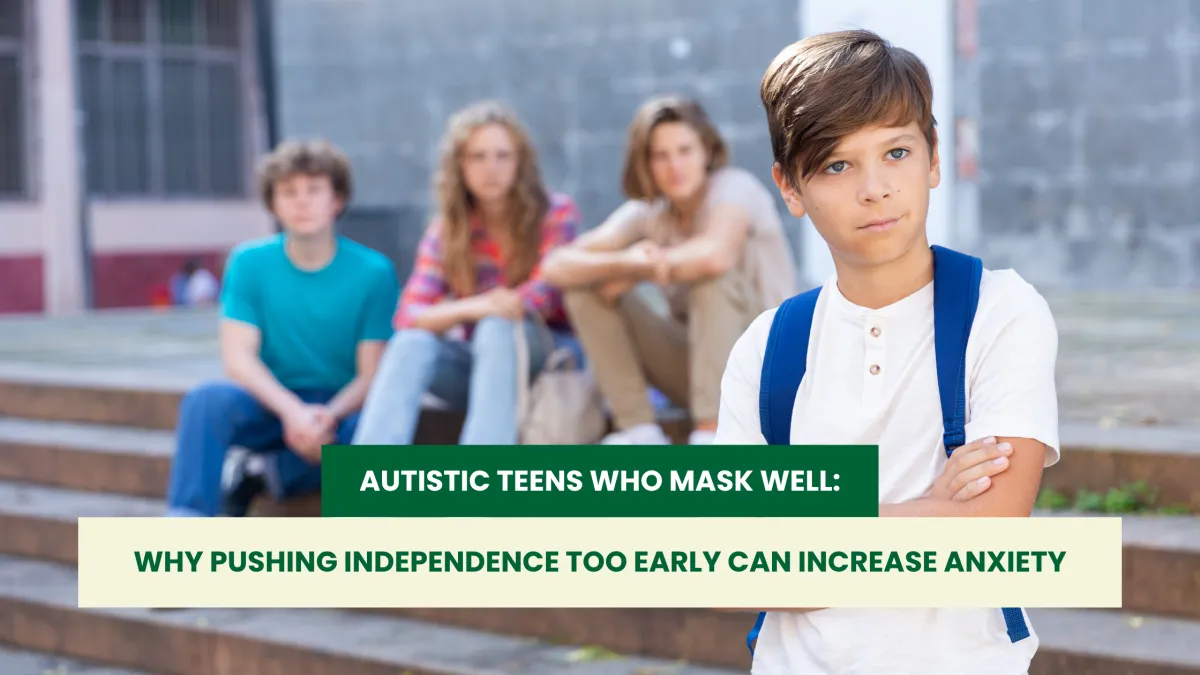
Autistic Teens Who Mask Well: Why Pushing Independence Too Early Can Increase Anxiety
If you are parenting an autistic teenager who masks well, you may feel growing pressure to help them become more independent.
You may be thinking about milestones like getting a driver’s license, preparing for college, keeping grades up, joining extracurricular activities, and learning life skills.
A common pattern I see in my clinical work is this. The more parents push for independence, the more anxiety the teen often feels.
Independence is not a bad goal. It is an excellent goal.
The issue is that regulation has to come first.
I am Dr. James Thatcher, a licensed clinical psychologist at Forest Psychological Clinic in Portland, Oregon. In this article, I am talking about autistic teenagers, especially Level 1 autistic teens who mask anxiety and internalize distress.
My goal is not to downplay independence. It is to explain why pushing it too early can increase anxiety, and what tends to work better instead.
If you are in Portland, Oregon or nearby and want support for your teen or family, you can request a consultation for therapy or an evaluation at forestpsychologicalclinic.com.
The biggest misunderstanding: independence and support are not opposites
One of the biggest misunderstandings I see is the idea that independence and support are opposites.
Parents often worry that if they provide too much support, their teenager will never become independent.
Clinically, that is not how it works.
Independence is not the opposite of support.
Independence is often the result of regulation.
For many autistic teens who mask well, a large part of the day is spent managing their nervous system without anyone noticing.
They manage their behavior, tone, facial expressions, and social timing.
They manage sensory sensitivities like lights, noise, textures, crowds, and constant transitions.
They manage social uncertainty and performance demands at school.
From the outside, it can look like everything is fine.
Internally, they are working incredibly hard just to hold it together.
Why masking makes anxiety harder to see
Level 1 autistic teens are often overlooked because they can “pass” for most of the day.
Teachers may report that they are doing well.
Grades may look stable.
Behavior may look fine at school.
But masking always comes with a cost.
Home is often where parents see the impact.
shutdown
withdrawal
increased irritability
blowing up over something that seemed small
This is not defiance.
This is not laziness.
This is not a lack of motivation.
This is nervous system fatigue.
The independence trap
This is where things often go sideways.
Parents see adulthood approaching and think:
They need to be ready.
They cannot fall behind.
They have to learn these skills now.
So we start adding more.
More academic demands.
More extracurricular activities.
More expectations around performance.
More milestones.
All of this is understandable and well-intentioned.
At the same time, the teen becomes more overwhelmed, more dysregulated, and more anxious.
The way I often frame it is this.
Families are trying to prepare the teen for independence without preparing their nervous system to handle stress.
When regulation does not come first, independence starts to feel threatening instead of empowering.
A quick word about anxiety
Anxiety is not something to eliminate.
Anxiety is a necessary emotion. It helps people prepare, problem solve, and stay safe.
The problem is not that your teen experiences anxiety.
The problem is when anxiety stays at a high level for too long and the nervous system cannot return to baseline.
When anxiety builds over time, adding responsibilities and pressure does not feel empowering.
It feels overwhelming.
Pushing independence in that state can reinforce anxiety instead of reducing it.
What “regulation first” looks like
Putting regulation first is not about removing expectations or avoiding growth.
It means changing the order.
Instead of asking, what should they be able to do by now, ask this.
How well are they recovering from stress?
Here are practical strategies that often help.
Reduce what is overwhelming before adding more
Take a clear look at what is on their plate.
Is it too much?
Is the time commitment too large?
Are there too many performance demands stacked together?
Reduce unnecessary activities before adding new ones.
Build in real downtime
Many autistic teens need real recovery time to reset.
This is not the same as collapsing at the end of the day.
It is planned downtime that supports the nervous system.
Support sensory needs without framing them as weakness
Sensory supports are not coddling.
They are accessibility.
This might include:
quieter spaces when possible
noise-canceling headphones
predictable routines
lighting adjustments
clothing accommodations
Measure readiness for independence by regulation skills
A major part of adulthood is not avoiding stress.
It is learning how to recover from it.
When stress inevitably happens, can your teen come back down?
Can they problem solve after they are regulated?
Can they recover without spiraling?
That is where real independence comes from.
When teens feel more regulated, confidence and independence often emerge naturally.
Not because independence was forced, but because the teen feels safer in their mind and body.
What I want you to take away
If your autistic teen is anxious, it does not mean you are failing as a parent.
More often than not, it means their nervous system needs more support before it can take on more independence and responsibility.
When we get the order right, regulation first and then independence, we are not lowering expectations.
We are making growth possible.
And we are helping teens build self-regulation skills that will serve them for the rest of their life.
Portland, Oregon support for autistic teens and families
If you are in Portland, Oregon or nearby and your teen is masking, burning out, or feeling overwhelmed by independence pressures, support can help.
At Forest Psychological Clinic, we provide therapy and comprehensive evaluations for autism as well as comprehensive ADHD asessments. You can request a consultation at https://forestpsychologicalclinic.com/contact
FAQ: Autistic teens, masking, anxiety, and independence
Why does my teen look fine at school but fall apart at home
Masking takes energy. Many autistic teens hold it together during the day and then experience shutdown, irritability, or emotional overload when they reach a safe environment.
Does supporting my teen prevent independence
Support does not prevent independence. Support often creates the regulation that makes independence possible.
How do I know if I am pushing independence too early
If you see anxiety rising, shutdown increasing, irritability climbing, or recovery time shrinking as expectations increase, your teen may need more regulation support before adding new responsibilities.
What does regulation first mean in practical terms
It often means reducing overwhelm, building downtime, supporting sensory needs, and measuring readiness by recovery from stress, not by milestones alone.
Is anxiety always a problem
Anxiety is a normal emotion. The concern is when anxiety stays elevated for long periods and the nervous system cannot return to baseline, making everyday demands feel threatening.
When should we consider therapy or an evaluation
If anxiety, shutdown, school stress, burnout, or life transitions are creating impairment, therapy and or an evaluation can clarify what is going on and guide supports that fit your teen’s needs.

