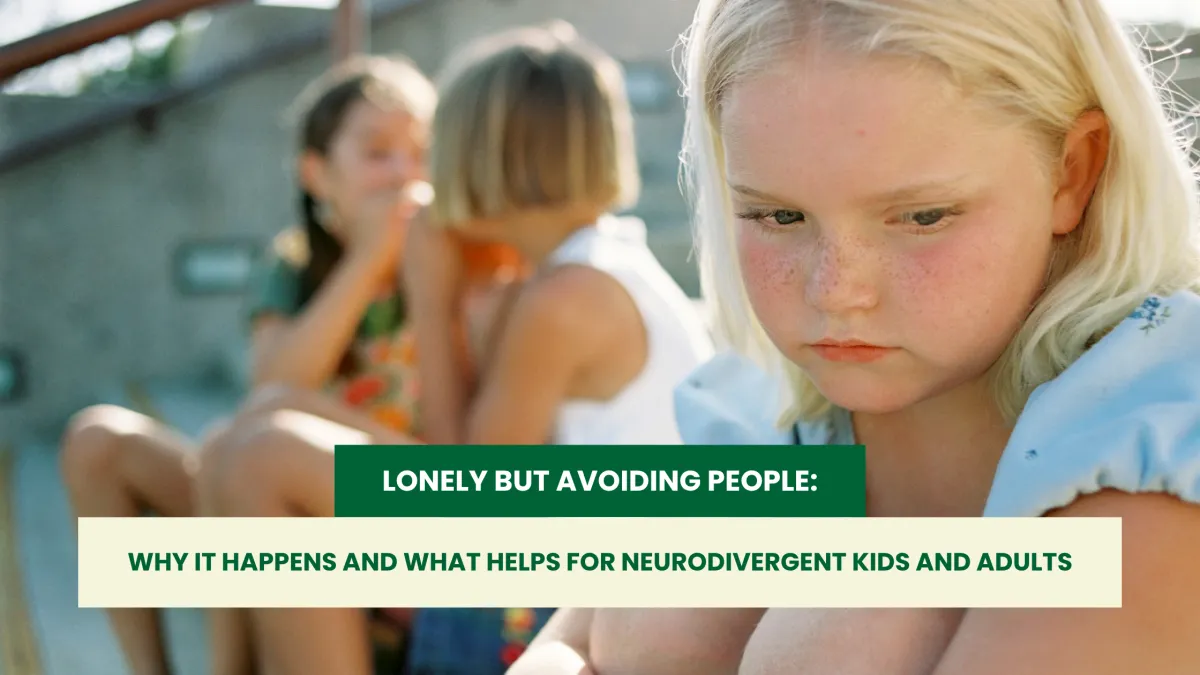
Lonely but Avoiding People: Why It Happens & What Helps for Neurodivergent Kids & Adults
If you are a parent and you have said to yourself, my kid is lonely but they also avoid people, you are not imagining things. That paradox is real.
And if you are an adult reading this and thinking, that is me, you are not alone.
At some point, social contact started to feel like it cost more than it gave back.
Parents describe it like this.
They want friends, but they do not approach anyone.
They are sad on weekends, but they refuse invitations.
They are lonely, but they eat lunch alone.
I want you to hear something right away.
Avoidance is not always about not caring. Sometimes it is about protection.
I am Dr. James Thatcher, a licensed clinical psychologist at Forest Psychological Clinic in Portland, Oregon. I work with kids, teens, and adults and have completed thousands of evaluations focused on autism and ADHD.
In this article, I am going to walk through three common drivers behind the lonely but avoiding pattern, how to spot which driver is most active, and a simple plan you can use this week.
If you are in Portland, Oregon or nearby and want support, you can learn more about therapy and evaluations at forestpsychologicalclinic.com.
Why someone can want friends and still avoid people
Here is a simple way to understand this pattern.
Some people want connection, but over time socializing starts to feel like too much.
Too many variables.
Too many unspoken rules.
Too much sensory input.
Too much risk of getting it wrong.
Too much effort for too little payoff.
So the brain does the math and decides, I want friends, but I cannot afford this right now.
If autism is part of the picture, diagnosed or not, this makes even more sense. Autism is a neurodevelopmental difference that can make social communication and social cue reading harder, not because someone does not want connection, but because the social manual was never obvious.
I hear people say this all the time.
Everybody else got the textbook except me.
Three common drivers behind lonely but avoiding
Driver 1: A social skills gap
This is one of the most common drivers.
Your child or you may want friends but not know how to do the mechanics.
How do I enter a group.
How do I start a conversation.
How do I keep it going.
How do I exit.
How do I recover after saying something awkward.
From the outside, it can look like they are not trying.
From the inside, it is often uncertainty plus pressure.
In kids, it can look like standing on the edge of the playground or eating lunch alone.
In adults, it can look like avoiding small talk at work, skipping gatherings, and then beating yourself up afterward.
This is not laziness. It is a missing road map.
Driver 2: Rejection history
This driver is not just skills. It is protection.
If a child tries repeatedly and is corrected, laughed at, excluded, bullied, or misunderstood, the nervous system learns something.
Social risk equals pain.
Once that pattern is learned, avoidance becomes understandable. Not as preference, but as self-protection.
In clinical work, I often hear the shame spiral that follows rejection history.
I should have tried harder.
I should have said it differently.
Why do I always come off awkward.
I blew it.
That line of thinking is not a character flaw. It is a person carrying shame.
When rejection history is the driver, the goal is not pushing harder. The goal is rebuilding safety around trying.
Driver 3: Social anxiety
Social anxiety is fear of being judged and fear of being seen making a mistake.
It can exist on its own or overlap with autism, ADHD, and rejection history.
When someone believes they will get it wrong, the body tends to respond in predictable ways.
Avoidance.
Freezing.
Masking so hard that they crash later.
In kids, this can look like a meltdown after a birthday party or shutdown after school.
In adults, it can look like holding it together at work and collapsing at home, then replaying conversations and worrying about what was said.
What not to do, even if you mean well
Two common mistakes can make this worse.
Do not punish avoidance. Punishment teaches social situations are dangerous and my parent does not get it.
Do not start by forcing big group situations. Groups have too many variables, too much sensory input, and too much complexity. If the goal is connection, the starting point must be doable.
A simple plan you can use this week
The goal is not to make someone act normal. The goal is to make connection doable.
Step 1: Start with one-on-one
One person is easier than five.
One-on-one lowers complexity and increases the chance of success.
For parents, think about the safest possible peer.
For adults, think about the lowest-pressure person to practice with.
Step 2: Make it structured and predictable
Do not say, just hang out.
Use an activity.
Play a game. Build something. Go for a short walk. Watch a show. Do a shared interest.
Structure lowers variables. Lower variables lowers anxiety.
You can also add a clear time limit.
An hour, then we are done.
Knowing when it ends often makes it easier to start.
Step 3: Practice scripts, but keep personality
Scripts can help with mechanics.
How to greet.
How to keep a conversation going.
How to exit.
How to recover after something awkward.
Scripts are useful.
But the goal is not to turn someone into a social robot.
It is okay to be a little odd. That is personality.
The goal is not perfect performance. The goal is real connection that does not require constant masking.
When an evaluation or therapy can help504 Plan vs IEP in plain language
If this pattern is causing significant impairment and you do not have clarity yet, an evaluation can help identify whether autism, ADHD, anxiety, or other factors are contributing. It can also support access to accommodations at school or work.
If you already have a diagnosis or strong suspicion, therapy or coaching can help build a tailored road map for social confidence, regulation skills, self-advocacy, and real-world strategies that evolve as life changes.
Portland, Oregon support
If you are in Portland, Oregon or nearby and want help with autism, ADHD, social anxiety, masking, or burnout, Forest Psychological Clinic offers neuroaffirming therapy and comprehensive evaluations.
You can learn more at forestpsychologicalclinic.com.
FAQ: Lonely but avoiding people
Can someone be lonely and still avoid people
Yes. Many people want connection but avoid it because it feels overwhelming, confusing, exhausting, or emotionally risky.
Is avoiding people a sign of autism
It can be, but not always. Avoidance can also be driven by social anxiety, depression, sensory overload, rejection history, or burnout. The driver matters more than the surface behavior.
How do I tell if it is a skills gap or anxiety
Skills gaps often look like not knowing what to do next. Social anxiety often looks like knowing what to do but feeling fear, self-consciousness, or dread that blocks action. Many people have both.
Should I force my child into group activities
Usually no. Start smaller. One-on-one and structured activities are often more successful and less overwhelming.
What is the best first step
Make connection simpler and more predictable. Choose one-on-one, build it around a shared activity, and keep the time limited. Momentum is built through doable wins.
When should we seek professional help
If avoidance is persistent, increasing, impacting school or work, or leading to significant sadness or self-esteem issues, therapy or an evaluation can help clarify the drivers and build a realistic plan.

