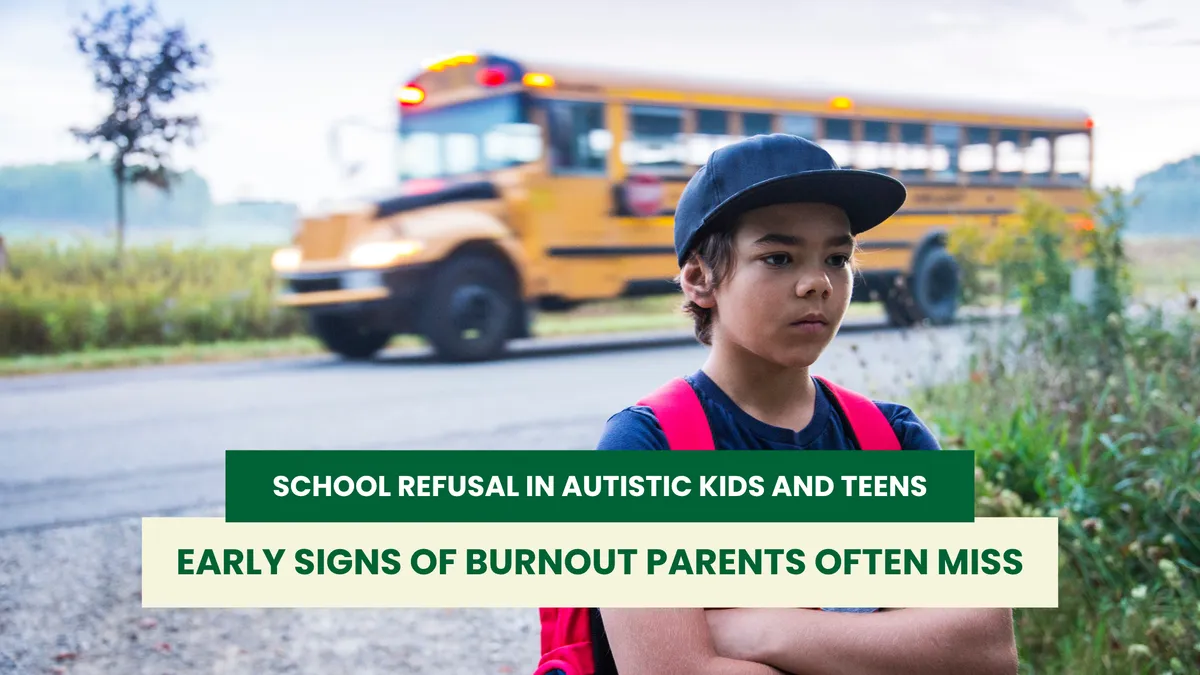
School Refusal in Autistic Kids and Teens: Early Signs of Burnout Parents Often Miss
A child usually doesn't wake up one morning and suddenly refuse to go to school.
More often, their world has been getting smaller for weeks or months.
Maybe they used to eat dinner with the family, but now they stay in their room.
They used to see a friend on weekends. Now they don't want to see anybody.
They used to tolerate family outings, sports, or activities. Now leaving the house feels like too much.
Homework starts taking longer.
Sleep changes.
They become more irritable.
Then come the stomachaches.
The requests to come home early.
The missed classes.
And eventually:
"I can't go to school."
By the time school refusal becomes obvious, a child may have been struggling for quite a while.
That's why I want parents to know what to look for before everything reaches a crisis.
What Is School Refusal?
School refusal generally describes a pattern where a child or teenager has significant difficulty attending or remaining at school.
But I don't love stopping at the phrase "school refusal," because refusal only tells us what the child is doing.
It doesn't tell us why.
A child might avoid school because of:
Anxiety
Depression
Autistic burnout
ADHD and executive-function difficulties
An unidentified learning disorder
Sensory overload
Bullying
Social difficulties
Academic pressure
Sleep problems
A difficult classroom environment
Several of these things happening at once
If we jump straight from:
"My child won't go to school"
to:
"How do I make them go?"
we can miss the actual problem.
The better question is:
"What has changed that is making school so difficult?"
Autistic Students Are More Likely to Experience School Absence
There is growing research showing that school attendance can be particularly difficult for autistic students.
A 2024 scoping review by Nordin and colleagues examined 42 studies on school absenteeism in autistic children and adolescents.
The researchers found that autistic students were more likely to be absent from school than non-autistic students.
School absence was frequently associated with mental-health concerns and additional neurodevelopmental conditions. But the research also pointed toward problems within the school environment itself, including bullying and a lack of understanding about autism (Nordin et al., 2024).
That's an important distinction.
Sometimes the child isn't the only thing that needs to change.
Sometimes the environment needs to change too.
The Early Warning Sign: Their World Starts Getting Smaller
One of the first things I watch for is not necessarily missed school.
It's shrinking.
What has quietly dropped out of your child's life?
Maybe they used to come downstairs for dinner.
Now they're eating alone.
Maybe they used to see friends.
Now they're declining every invitation.
Maybe they used to go grocery shopping with you, attend family activities, or play a sport.
Now almost everything outside the house is:
"No."
You may also notice changes in:
Sleep
Appetite
Hygiene
Sensory tolerance
Frustration tolerance
Friendships
Homework
Family interaction
Activities they previously enjoyed
One change by itself doesn't prove anything.
I'm looking for a pattern of changing functioning.
Preferred Interests Aren't Necessarily the Problem
Parents sometimes notice that while their child's world gets smaller, one preferred activity gets much bigger.
Maybe they're gaming for hours.
Drawing constantly.
Building LEGO.
Researching one topic.
Watching the same series repeatedly.
And parents understandably think:
"This is the problem. They're obsessed with this."
Maybe.
But often I want to ask something different.
What disappeared around the interest?
If your child has always loved gaming and still has friends, eats dinner with the family, manages school, and engages in other activities, that is one thing.
But if they used to do all of those things and now gaming is the only thing they can tolerate, I would pay attention.
For a neurodivergent child, a preferred interest may be one of the few places that still feels predictable and regulating.
School is unpredictable.
People are unpredictable.
Social interactions are confusing.
Assignments pile up.
Transitions happen all day.
Then they come home and open a game where the rules make sense.
The question shouldn't automatically be:
"How do we stop this interest?"
Sometimes the better question is:
"Why has everything else become so hard?"
What Does Autistic Burnout Look Like in Kids and Teens?
Research into autistic burnout in children is still relatively new, so I don't want to pretend we have every answer.
But we are starting to hear directly from autistic young people.
Phung and colleagues published a 2021 study in Frontiers in Psychology where they interviewed eight autistic children and youth about burnout, inertia, meltdowns, and shutdowns.
The young people described these experiences as involving combinations of physical, emotional, and cognitive difficulties.
They also described how adults sometimes misunderstood what they were experiencing.
One of the major takeaways from the study was the importance of compassion and collaboration from trusted adults rather than adults simply imposing solutions on the young person (Phung et al., 2021).
That's very similar to what I see clinically.
When functioning starts changing, curiosity tends to get us much further than punishment.
Burnout Can Look Like Laziness or Defiance
This is where families can get stuck.
Your child is bright.
They understand the material.
The teacher says:
"They're perfectly capable of doing this."
And yet assignments suddenly aren't getting done.
Maybe they:
Stop turning in work
Forget assignments
Procrastinate until the last minute
Open the laptop and stare at it
Lose track of what's due
Struggle to break large projects into steps
Panic when deadlines arrive
Start earning lower grades despite understanding the material
From the outside, parents or teachers may interpret this as:
"They don't care."
"They're lazy."
"They're being defiant."
But before deciding that this is a character problem, ask:
Is this child unwilling to do something, or are they losing reliable access to skills they previously had?
Those are two very different problems.
And they require very different interventions.
"My Child Looks Fine at School"
I hear this one all the time.
A parent says:
"Something is really wrong."
The school says:
"We don't see it. They're fine here."
Both may be telling the truth.
Some autistic and neurodivergent kids spend virtually all of their available energy holding themselves together at school.
They're quiet.
They follow instructions.
They don't melt down.
They get through the day.
Then they get home.
And everything falls apart.
So a child looking calm from 8:00 to 3:00 doesn't necessarily tell us what those seven hours cost them.
If your child comes home and immediately needs to isolate for four hours, cannot tolerate conversation, melts down over small requests, or spends the entire weekend recovering enough to go back Monday, that's important information too.
Watch the Whole Child, Not Just the Report Card
Parents understandably pay attention to grades.
But grades are only one piece of functioning.
Ask:
Are they sleeping?
Are they eating?
Are they showering?
Are they talking to friends?
Are they participating in family life?
Are they doing anything for enjoyment besides one highly regulating activity?
Can they recover over the weekend?
Or is Saturday spent recovering from the previous week and Sunday spent panicking about the next one?
A straight-A student can still be doing terribly.
And a child whose grades are falling may have something much more important going on than academics.
Sometimes Behavior Is Communication
I once worked with a teenage girl whose grades started falling.
She stopped hanging out with her friends.
She became increasingly withdrawn at home.
But she never told her parents:
"I'm being bullied."
Because she didn't realize that's what was happening.
She believed this group of kids were her friends.
But their interactions were confusing.
Someone would tell her one thing.
Then another person would tell her something different.
They would make fun of her directly, but subtly enough that she wasn't sure whether they were joking.
She kept thinking:
Are they my friends?
Am I misunderstanding something?
Is this just how people joke?
All she really knew was:
Something feels wrong.
Her Parents Didn't Wait for Her to Explain Everything
Her parents noticed the change.
Her grades were falling.
She wasn't seeing friends.
She was withdrawing.
They asked what was wrong.
She couldn't explain it.
So they started investigating.
They contacted the school.
They talked with her counselor.
They talked with teachers.
And the adults started paying closer attention.
Eventually, they noticed something.
A particular group of boys would approach her.
They would interact with her.
Then she would walk away visibly upset.
And it kept happening.
Now the adults had information the teenager herself didn't yet know how to put into words.
Autistic Students Are at Increased Risk for Bullying
This is one reason I think bullying needs to be actively considered when an autistic child's relationship with school suddenly changes.
Park and colleagues published a 2020 meta-analysis examining 34 studies of bullying among autistic students.
Across those studies, autistic students had a significantly higher risk of being bullied than typically developing students and students with other disabilities.
The pooled estimate of bullying victimization was high, although rates varied substantially across studies and depended on things like age, culture, school environment, and research methodology (Park et al., 2020).
So I wouldn't use one percentage to describe every autistic child's risk.
But the larger point is clear:
Autistic children and teenagers are at increased risk for bullying victimization.
And bullying doesn't always look obvious.
Bullying Isn't Always Someone Shoving a Kid Into a Locker
Sometimes bullying looks like:
Social exclusion
Manipulation
Rumors
Group chats
Kids pretending to be someone's friend
Deliberately giving conflicting information
"Jokes" that are actually cruel
Convincing someone to do something embarrassing
Subtle comments designed to confuse or humiliate them
That can be especially difficult for an autistic student who already struggles to interpret social intent.
A child may know:
"I feel terrible around these people."
long before they're able to say:
"These people are bullying me."
In that case, the change in behavior may actually be the communication.
What Happened After Adults Identified the Problem?
Once the girl's parents, teachers, and counselor understood what was happening, they could actually intervene.
They developed a plan.
Who would monitor the situation?
What happens if those students approach her?
Who does she go to for help?
What interactions are acceptable?
What happens if the behavior starts again?
Luckily, this happened near the end of the school year, which gave her some time over the summer to decompress.
When she returned, she had a plan.
Her functioning improved.
That's why the story matters.
The solution wasn't:
"Try harder."
It wasn't:
"You're grounded because your grades dropped."
And it wasn't:
"There's something emotionally wrong with you."
They found the actual problem.
Then they addressed it.
Don't Wait for Your Child to Give You the Perfect Explanation
Parents sometimes ask:
"What's wrong?"
Their teenager says:
"I don't know."
Then:
"Why don't you want to go to school?"
"I don't know."
"Did something happen?"
"I DON'T KNOW."
Eventually everybody is frustrated.
But sometimes "I don't know" is accurate.
A child may know:
I'm exhausted.
I don't feel safe.
Everything feels too hard.
I can't do this anymore.
without being able to tell you exactly why.
Children should not have to give their parents a perfectly organized clinical explanation before adults start taking the change seriously.
Sometimes you're going to have to help them investigate.
Ask Better Questions About School
Instead of:
"Why aren't you doing your work?"
try:
"What's making it hard to start?"
Instead of:
"Why are you refusing school?"
try:
"Which part of school feels hardest right now?"
Instead of:
"Why are you being lazy?"
try:
"I've noticed that things that used to be easier seem harder lately. What have you noticed?"
You can also get specific.
Is it:
Getting up in the morning?
The bus?
First period?
Lunch?
A particular teacher?
The noise?
A certain classroom?
Keeping track of assignments?
Writing?
Reading?
Other students?
Being called on unexpectedly?
Transitions?
PE?
The amount of homework?
You don't have to solve everything during the first conversation.
You're trying to find the thread.
Parents and Schools Need to Share Information
Parents know the child at home.
Teachers know the student at school.
Counselors may see another side.
Nobody necessarily has the whole picture.
If the school says:
"They seem completely fine here."
you can say:
"I understand you're not seeing this at school, but we're seeing a significant change at home. Can you help us monitor for anything we might be missing?"
That's not an accusation.
It's collaboration.
Ask teachers whether assignments are changing.
Ask about peer interactions.
Ask where your child spends lunch.
Ask whether they're asking to visit the nurse.
Ask whether they're completing work in class.
Ask if they're suddenly sitting alone.
Get information.
What Can Parents Do Before School Refusal Becomes a Crisis?
First, look for patterns across the child's whole life.
Not just grades.
Then try to identify the underlying problem.
Is it:
Bullying?
Address the bullying.
Executive-function overload?
Break tasks down, externalize deadlines, and make expectations clearer.
Difficulty writing?
Speech-to-text or other assistive technology may help.
Sensory overload?
Consider quieter spaces, seating changes, noise-reducing headphones, or other appropriate accommodations.
Anxiety or depression?
Mental-health treatment may be needed.
A possible learning disability?
It may be time for a comprehensive evaluation.
The intervention depends on the mechanism.
That's why understanding the why matters so much.
Consequences Don't Teach a Missing Skill
I am not saying kids should never have expectations or consequences.
Of course they should.
But consequences work best when the child actually has the skills and capacity to meet the expectation.
If a child cannot organize a long-term project, taking away their phone doesn't teach planning.
If they're being bullied, grounding them doesn't make school safe.
If the fluorescent lighting and noise are overwhelming them, punishment doesn't reduce the sensory load.
Before asking:
"What consequence should we give?"
ask:
"What problem are we actually trying to solve?"
When Should You Consider a Psychological Evaluation?
If your child's functioning has changed significantly and you don't understand why, an evaluation can sometimes help identify what is underneath the school difficulty.
That may include questions about:
Autism
ADHD
Anxiety
Depression
Learning disabilities
Executive functioning
Adaptive functioning
Social difficulties
Sensory concerns
Other factors affecting school performance
The goal shouldn't simply be getting a diagnosis.
The goal should be getting a roadmap.
What is making school hard?
What does this child need?
What can the family change?
What can the school change?
What accommodations or interventions actually match the problem?
Autism and ADHD Evaluations in Portland, Oregon
At Forest Psychological Clinic, we provide comprehensive autism, ADHD, and psychological evaluations for children, teens, and adults in the Portland, Oregon area.
We also provide therapy and medication management.
For children struggling with school, we want to understand more than whether they're completing assignments.
We look at the larger picture, including executive functioning, learning, emotional health, social experiences, sensory needs, adaptive functioning, and what has changed over time.
If you're trying to understand why your child is struggling with school refusal, burnout, ADHD, autism, anxiety, or learning concerns, you can learn more at ForestPsychologicalClinic.com
The Bottom Line
If your child's world is getting smaller, pay attention.
Don't immediately jump to:
Lazy.
Defiant.
Unmotivated.
Get curious first.
What changed?
What's happening at school?
What's happening socially?
What's happening with sleep?
What's happening with homework?
What's happening with sensory tolerance?
What is your child no longer able to do that they used to be able to do?
Sometimes your child isn't giving you a hard time.
They're having a hard time and don't yet have the words to explain why.
The earlier adults understand what's underneath the behavior, the more options we have.
You don't have to wait until your child completely crashes before deciding something needs to change.

