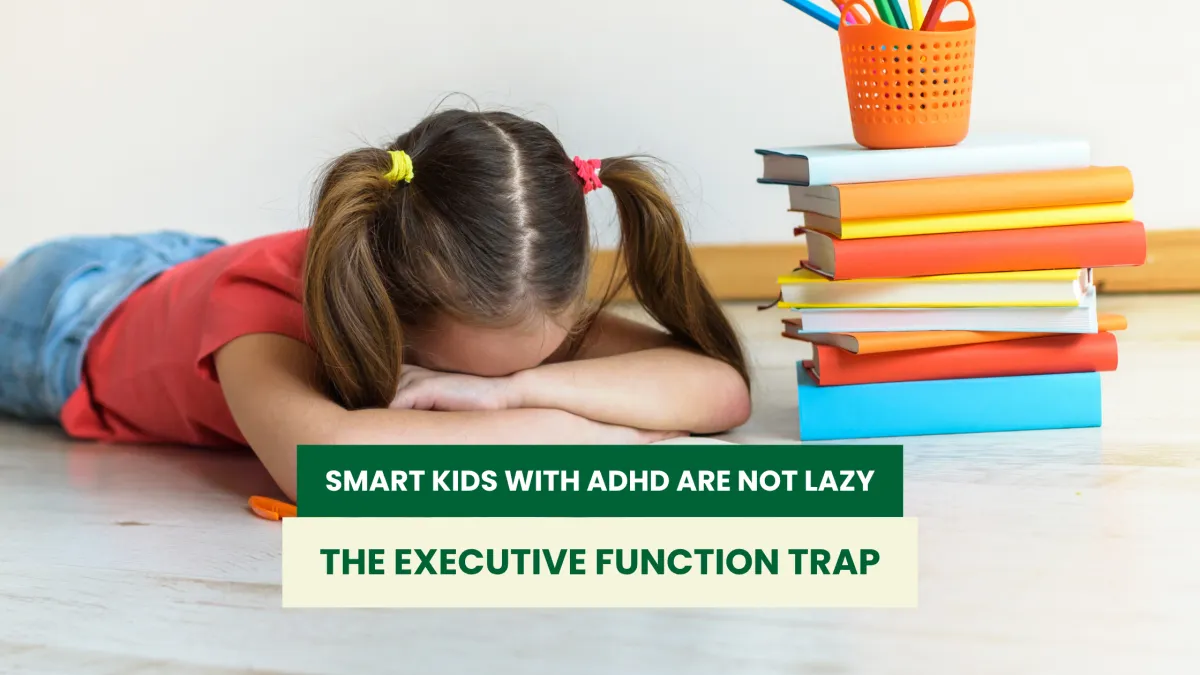
Smart Kids With ADHD Are Not Lazy: The Executive Function Trap
Many smart kids with ADHD are not lazy.
They are stuck.
A child may be bright, curious, creative, and capable of deep thinking, but still struggle to start homework, follow morning routines, manage time, organize assignments, or complete schoolwork without a battle.
Parents often describe the same confusing pattern:
“My child is so smart, but homework is a nightmare.”
“They can explain complicated topics, but they cannot start a basic assignment.”
“Sunday nights are full of panic.”
“Mornings feel like a daily emergency.”
“They say they don’t care, but I can tell they are overwhelmed.”
If this sounds familiar, the issue may not be intelligence or motivation.
It may be executive functioning.
At Forest Psychological Clinic in Portland, Oregon, we work with children, teens, and families navigating ADHD, executive functioning challenges, anxiety, school stress, and neurodivergence. One of the most important things parents can understand is this:
Executive functioning is not the same as intelligence.
What Is Executive Functioning?
Executive functioning is the brain’s management system.
It helps a child:
Start tasks
Remember directions
Organize materials
Plan steps
Estimate time
Shift between activities
Manage emotions
Prioritize what comes first
Follow through until a task is complete
For kids with ADHD, these skills can be inconsistent.
A child may know what the assignment is but not know where to begin. They may understand the material but lose track of the directions. They may intend to start in five minutes and suddenly it is midnight.
That does not mean the child is lazy.
It means the process of school requires many executive functioning skills at once, and ADHD makes that process harder to manage.
Why Smart Kids With ADHD Struggle in School
School does not only measure what a child knows.
It also requires a child to manage the process of learning.
A student has to remember assignments, track deadlines, bring materials home, understand directions, start work, stay with the task, tolerate frustration, organize answers, turn work in, and repeat the process the next day.
For a child with ADHD, each of those steps can create friction.
That is why a smart child may be able to talk about complex ideas but still struggle to complete a worksheet.
The intelligence may be there.
The executive functioning support may not be.
Common Executive Functioning Challenges in ADHD
Working Memory
Working memory is the ability to hold information in mind while using it.
A child with working memory challenges may forget multi-step directions, lose track of what they were doing, or need instructions repeated.
Task Initiation
Task initiation is the ability to start without repeated prompting.
A child may know they have homework but feel unable to begin. The task may feel too vague, too large, too boring, or too emotionally loaded.
Planning and Organization
Planning and organization help a child decide what comes first, what materials are needed, and how to sequence steps.
Without support, a child may stare at the assignment and feel overwhelmed before they even begin.
Time Blindness
Time blindness means a child has difficulty feeling time accurately.
They may say, “I’ll do it in five minutes,” and then an hour passes. They may drastically underestimate how long homework will take.
Emotional Regulation
Emotional regulation is the ability to stay calm enough to problem-solve.
When a child becomes flooded with frustration, panic, anger, or shame, their ability to plan and organize can drop quickly.
This is why ADHD homework struggles are often emotional, not just organizational.
The Smart Kid Procrastination Trap
Many bright kids with ADHD fall into a predictable cycle.
Step 1: Procrastination
The child avoids the assignment.
Not necessarily because they do not care, but because they do not know where to start, missed the directions, feel overwhelmed, or are afraid they will not do it well.
Step 2: Last-Minute Panic
The deadline gets close.
Now the pressure is high enough to activate the brain. The child works late into the night, fueled by panic and fear.
Step 3: They Pass Anyway
Because the child is bright, they may still turn in the assignment and get a decent grade.
This part is tricky because it teaches the nervous system that the strategy worked.
Step 4: Avoidance Gets Reinforced
The child learns:
“I can put it off, panic, get it done, and survive.”
This reinforces the cycle.
Step 5: Anxiety and Burnout Build
Over time, the cost rises.
The child loses sleep. Sunday nights become stressful. Homework becomes a crisis. Parents become more frustrated. The child becomes more anxious, ashamed, and burned out.
This is the trap.
A child may be smart enough to survive short term, but not supported enough to function sustainably.
“I Don’t Care” May Be Armor
Many parents hear their child say:
“I don’t care.”
But often, “I don’t care” is not the full truth.
It may be protection.
A child may say they do not care because it feels safer than saying:
“I do not know where to start.”
“I am afraid I will mess this up.”
“I feel stupid.”
“I waited too long and now I am panicking.”
“I do not know how to fix this.”
“I feel like I am failing.”
When parents understand this, the response can shift.
The goal is not to excuse avoidance.
The goal is to understand what is underneath it.
Emotional Dysregulation Can Block Executive Functioning
For many kids with ADHD, emotional dysregulation is the bottleneck.
When a child is overwhelmed, their ability to plan, organize, remember steps, start tasks, and problem-solve decreases.
That may look like:
Crying
Anger
Panic
Shutting down
Refusing
Saying “I can’t”
Saying “This is stupid”
Leaving the room
Arguing or melting down
This is not always defiance.
It may be a nervous system response.
When a child is emotionally flooded, pushing harder often does not build executive functioning. It can add more stress to a system that is already overloaded.
The sequence matters:
Regulate first. Then build skills.
Parent Strategy 1: Use the Five-Minute Action
When a child with ADHD is stuck, the full task may feel too big.
Instead of saying, “Finish your homework,” ask:
What can we do in the next five minutes?
Examples of five-minute actions include:
Open the laptop
Log into the school portal
Find the assignment
Read the first two directions
Write your name and date
Do one math problem
Find the book
Put the worksheet on the table
This is starting-line thinking, not finish-line thinking.
Many ADHD kids panic when they see the whole mountain. A five-minute action helps them find the first foothold.
Parent Strategy 2: Externalize the Brain
If the whole plan lives inside your child’s head, it may disappear when emotions rise.
Make the plan visible.
Helpful tools may include:
Visual checklists
Written homework steps
First-then plans
Visual timers
Whiteboards
Sticky notes
Assignment trackers
Morning routine charts
For example:
First: Math for 20 minutes
Then: 10-minute break
Or:
First: Read two pages
Then: Snack
This is not babying your child.
It is building structure outside the brain so your child can use it when their internal system gets overwhelmed.
Parent Strategy 3: Use Chunks and Breaks
“Do all your homework” is too big for many kids with ADHD.
Chunk the work.
Instead of saying, “Finish everything,” try:
“For the next 20 minutes, we are only doing math.”
“After that, we will take a 10-minute break.”
“Then we will do 20 minutes of reading.”
“Then we will pause again.”
Chunking helps reduce catastrophizing.
The task is no longer:
“This will take forever.”
It becomes:
“I can do 20 minutes.”
Chunking also protects regulation. And regulation protects thinking.
What to Say When Your Child Says “I Can’t”
When your child says, “I can’t,” try not to argue with the sentence.
Saying “Yes, you can” may be technically true, but it can quickly turn into a power struggle.
Instead, try this four-step response.
1. Reflect the emotion
“That feels really overwhelming right now.”
2. Get curious
“What part feels too big? Is it starting? Is it not knowing what to do? Are you worried you will mess it up?”
3. Reality-test gently
“Yes, this is a lot. But it is three assignments, not thirty. We can make it smaller.”
4. Offer a micro-step
“Let’s do math for 20 minutes, then take a break.”
If your child is highly escalated, pause first.
You might say:
“Your body is really activated right now. Let’s take five minutes to settle, and then we will start with the first step.”
This response validates the child’s experience while still holding structure.
ADHD Morning Routines Need Systems
For many families, mornings are the hardest part of the day.
Getting out of bed, taking medication, eating breakfast, getting dressed, packing the backpack, finding shoes, and leaving on time can become a daily crisis.
Many kids with ADHD set alarms too early and hit snooze repeatedly. This often fragments sleep and increases frustration.
A better approach may be to set the alarm for when the child actually needs to get up and then use an external morning routine system.
A morning checklist might include:
Bathroom
Medication
Breakfast
Shower
Get dressed
Pack bag
Shoes
Leave
For some kids, it helps to put times next to each step.
Time needs to be visible.
It also helps to reduce morning decisions the night before.
Prepare ahead by:
Packing the backpack
Choosing clothes
Preparing lunch
Charging devices
Putting shoes in the same place
Signing school forms
Checking the next day’s schedule
If your child’s lateness is making you late for work every day, that does not mean you are too strict.
It means the system is not working yet.
Systems can be changed.
What Not to Do With ADHD Procrastination
Some common parent responses can accidentally reinforce the procrastination trap.
Avoid Nagging Loops
Repeated reminders often escalate stress for everyone. The parent becomes more frustrated, the child becomes more overwhelmed, and executive functioning drops.
Avoid Consequences Without a Plan
Consequences may have a place, but if there is no workable system for doing the task differently next time, the consequence becomes a threat rather than a teaching tool.
Avoid Rescuing Without a Plan
Parents often rescue because they care.
But if the pattern becomes procrastinate, panic, parent rescues, the child’s nervous system may learn that panic leads to rescue.
A healthier approach is scaffolding.
Support the child enough that they can learn, but not so much that the whole system depends on parent emergency mode.
When to Seek ADHD Support
Some parents wait to seek support because their child is still passing.
But passing does not always mean functioning.
A child can get good grades and still be anxious, sleep-deprived, burned out, and miserable.
It may be time to seek support if your child is experiencing:
Frequent homework battles
Sunday night dread
Morning panic
School refusal
Meltdowns around assignments
Chronic procrastination
Sleep loss from late-night work
Burnout
Anxiety around school
Parent-child conflict around homework
Difficulty starting or finishing daily tasks
Support may include therapy, parent coaching, executive functioning scaffolding, school accommodations, or a comprehensive evaluation if the full picture is unclear.
Autism and ADHD Evaluations in Portland, Oregon
Forest Psychological Clinic provides ADHD evaluations, autism evaluations, and therapy for children, teens, and adults in the Portland, Oregon area.
We help families understand whether ADHD, anxiety, learning differences, autism, executive functioning challenges, or emotional regulation difficulties are contributing to school struggles.
If homework battles, morning routines, procrastination, or school anxiety are taking over your home, an evaluation or therapy can help create a roadmap forward.
You can learn more at:
FAQ: Smart Kids With ADHD and Executive Functioning
Why does my smart child with ADHD struggle so much with homework?
Smart kids with ADHD often struggle with homework because homework requires executive functioning skills, not just intelligence. They must start, plan, organize, remember directions, manage time, tolerate frustration, and complete the task.
Is my child with ADHD lazy?
Usually, no. What looks like laziness may actually be difficulty with task initiation, time blindness, emotional regulation, working memory, or planning. ADHD affects the brain’s management system.
Why does my child procrastinate and then panic?
Procrastination can happen when a task feels overwhelming, boring, unclear, emotionally loaded, or hard to start. Panic creates urgency, which may temporarily help the brain activate, but this pattern increases anxiety and burnout over time.
Why does my child say “I don’t care” about school?
“I don’t care” may be emotional armor. Some children say this when they feel overwhelmed, ashamed, anxious, or afraid they will fail. It can protect them from feeling vulnerable.
What is executive functioning?
Executive functioning is the brain’s management system. It includes skills like starting tasks, organizing materials, planning steps, estimating time, remembering directions, regulating emotions, and following through.
How can parents help with ADHD homework battles?
Parents can help by using five-minute actions, visual checklists, timers, chunks and breaks, emotional validation, and micro-steps. The goal is to make the task visible and manageable.
What should I do when my child says “I can’t”?
Try reflecting the emotion, getting curious, reality-testing gently, and offering a small next step. For example: “This feels overwhelming. What part feels too big? Let’s just do 20 minutes of math, then take a break.”
Why are mornings so hard for kids with ADHD?
Mornings require many executive functioning skills at once: waking up, sequencing steps, managing time, remembering items, transitioning, and leaving on schedule. External routines and preparation the night before can help.
Does passing grades mean my child is functioning well?
Not always. Some children get good grades while losing sleep, panicking, burning out, or relying on last-minute crisis energy. Passing does not always mean the system is sustainable.
When should I seek an ADHD evaluation or therapy?
Consider support if homework battles, procrastination, morning panic, school refusal, emotional meltdowns, burnout, or executive functioning struggles are affecting your child’s well-being or family life.
Final Thoughts
Your smart ADHD child is not lazy.
They are not broken.
And you are not failing as a parent.
Their brain may be surviving school with a short-term strategy that hurts them in the long term.
The hopeful part is that the strategy can change.
With the right supports, your child can learn systems that are kinder, more sustainable, and more realistic for how their brain works.
The goal is not to make your child a different person.
The goal is to put the right support in the right place at the right time.

